
Off-Grid Caravan Camping: How Long Will Your Power and Water Last?
Off Grid - How long can I go?
Planning a free camp in your Dirt Gear off-road caravan? The two questions we get asked most are how long the batteries last and how far the water stretches. Here are straight answers to the questions every off-grid camper asks before heading bush.
How long can I camp off-grid in a hire caravan?
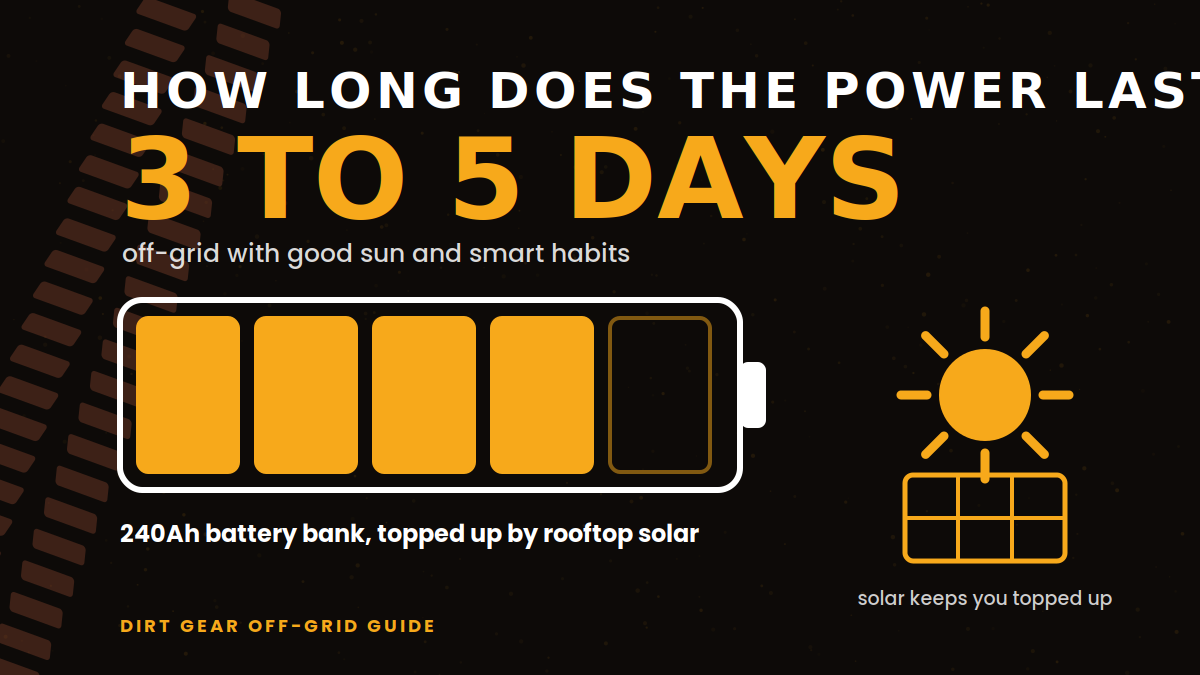
With good sunlight and sensible power habits, most Dirt Gear vans will comfortably run 3 to 5 days off-grid. Vans with larger battery banks, including our Harvok models, will stretch further. Water is usually the bigger limit for families, so plan your trip length around both.
How does the power system work in an off-grid caravan?
Your van runs on a 12V battery bank, typically 240 amp-hours or more, topped up by rooftop solar panels. The battery powers your fridge (some fridges run on gas), lights, water pump, fans and TV. Solar charging takes time, so how long your power lasts comes down to how efficiently you use it.
What affects how fast my caravan batteries drain?
Three things make the biggest difference:
Sunlight. Full sun, overcast skies or parking under shady trees all change how quickly your solar panels recharge the batteries.
What you run. Fridges, fans and lights all draw from the battery bank. The more you run, the faster it drains.
Your habits. Small changes, like opening windows instead of running fans all day, add days to your trip.
Can I use the air conditioner, microwave or power points off-grid?
It depends on the van. In most vans, 240V appliances such as air conditioning, the microwave, washing machine and standard power points only work when connected to mains power at a powered site.
Our Harvok 48V vans are the exception. Their 48V battery system can run the induction cooktop, 240V appliances and even the air conditioner off-grid. Some of our other vans have an inverter fitted, which lets you plug in a 240V appliance too. Just remember the golden trade-off: every 240V appliance you run draws serious power from the batteries, so the more you use them, the shorter your off-grid stay.
The smart approach is to save the batteries for the things only electricity can do, and use gas or the barbecue for everything else:
Boil water on the gas cooktop, not the kettle.
Cook on the Weber instead of the induction cooktop.
Open the windows instead of running the air conditioner.
Make toast on the gas cooker instead of the toaster.
Every one of those swaps is a free day of battery life over a long weekend.
How long does solar take to charge caravan batteries?
Longer than most people think, and the maths explains why.
A 400W solar panel sounds like plenty, but panels almost never deliver their full rated output. In real Australian conditions, expect around 70 to 80 percent, so a 400W panel puts roughly 25 amps into a 12V battery bank in strong midday sun.
Now the battery side. A 200 amp-hour battery charged at 25 amps needs about 8 hours of perfect sun to go from flat to full. Here is the catch: a day does not give you 8 hours of perfect sun. The sun is only strong enough to hit peak output for around 4 to 6 hours a day, called peak sun hours, even in a NSW summer. Morning and late afternoon sun charges at a fraction of that rate.
So the real answer: recharging a flat 200Ah battery from solar alone takes 1.5 to 2 days of good weather. This is exactly why the golden rules below matter. Solar is designed to top up what you use each day, not rescue a flat battery bank. Keep your daily usage below what the panels put back in and you can stay out almost indefinitely.
Does shade stop solar panels from working?
Yes, and worse than you would expect. On a standard solar panel, shade covering even part of the panel can shut down the output of the whole panel, because the cells are wired in series and the shaded section chokes the rest. Parking half under a gum tree can cost you nearly all your charging.
Newer shade-resistant panels, sometimes called split-cell or half-cut panels, are wired so that shade on one section only knocks out that section. Cover half the panel and you still get roughly half the output instead of none.
The practical takeaway either way: park the van in full sun where you can, and if you are stuck with a shady site, a solar blanket you can move around to chase the sun is worth its weight in gold.
How do I make my caravan batteries last longer off-grid?
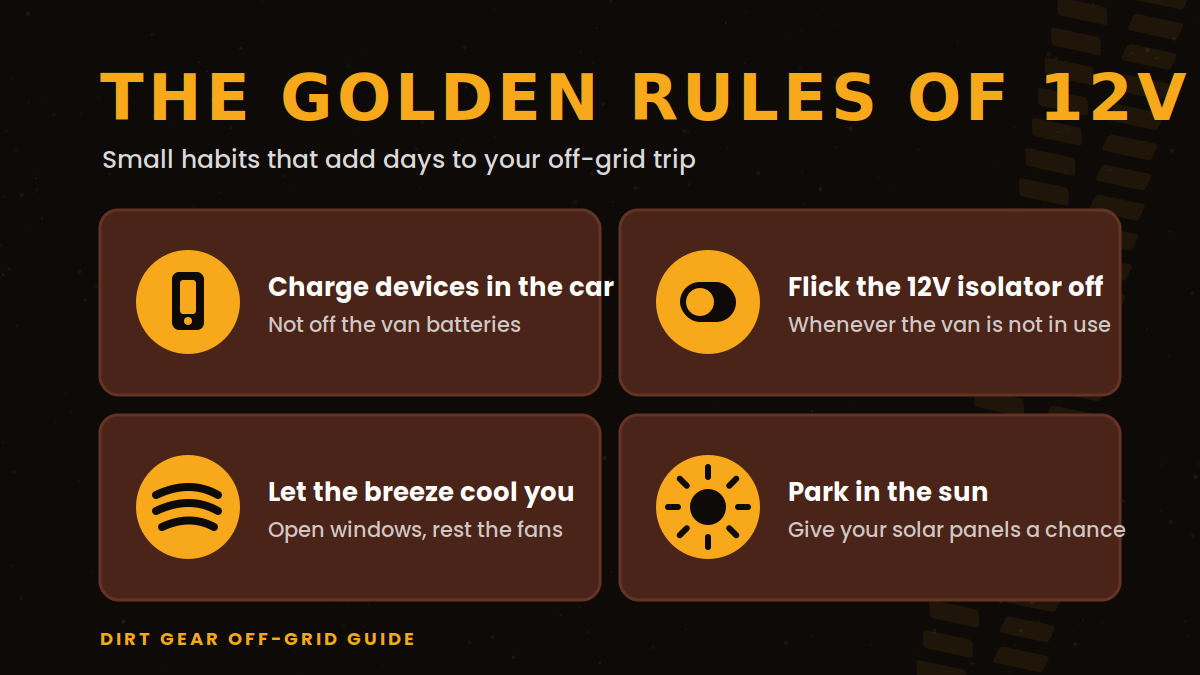
Follow these golden rules:
Charge phones and tablets in the car on travel days, not off the van batteries.
Switch off the van's 12V isolation switch whenever the van is not in use.
Open windows and use the breeze instead of running fans all day.
Park in sun where possible so your solar panels can do their job.
For longer trips, top up via your car's alternator while driving, or add a solar blanket. A solar blanket is brilliant for chasing the sun when your van is parked in shade.
One warning worth remembering: if you run the batteries flat, you have a very expensive tent. You will not even be able to flush the toilet.
How much water does a hire caravan carry?
All Dirt Gear vans carry around 200 litres of fresh water, filled with town water before delivery. This supplies your sink, shower and toilet.
How long does 200 litres of water last when camping?
It depends almost entirely on showers. A 10-minute shower burns through water surprisingly fast. Keep showers short and a couple can stretch 200 litres across 4 to 5 days. Long showers every day and you will be refilling within 2 to 3 days.
How does hot water work in an off-grid caravan?
Most caravan hot water systems run on 240V, gas or diesel, hold about 20 litres, and take 30 to 50 minutes to heat. That means one long shower can drain your entire hot water supply, then you wait for it to reheat. Short showers keep everyone happy.
How do I refill the water tank at camp?
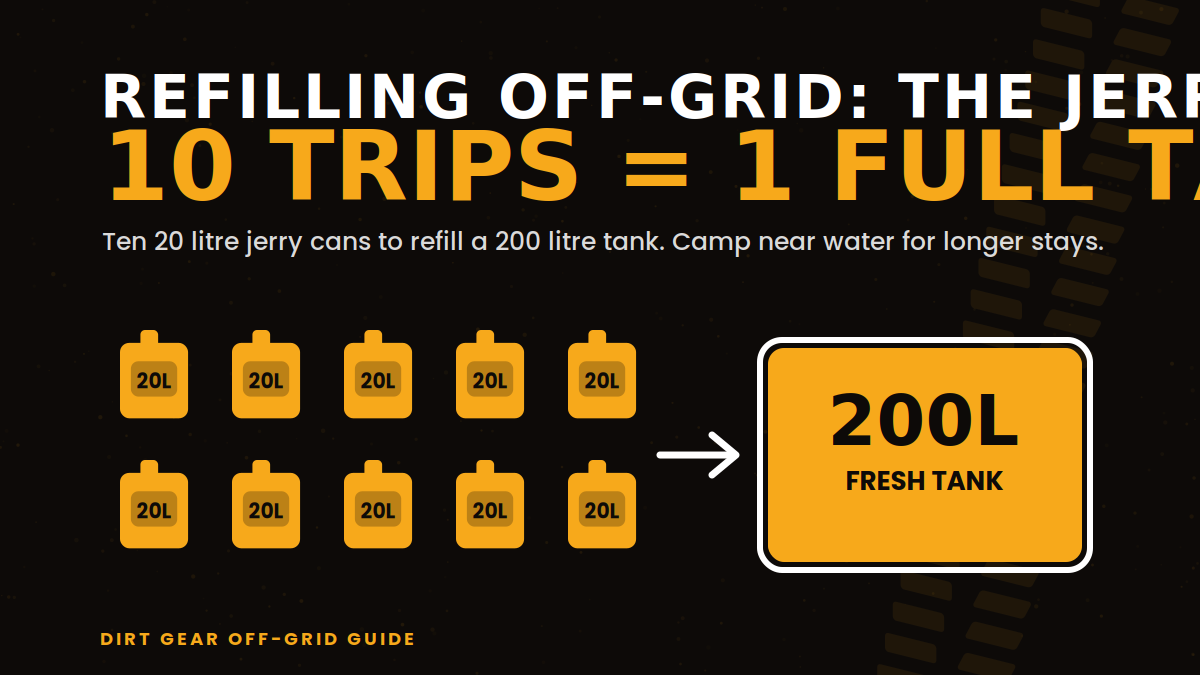
Top up via the water filler on the side of the van. Most jerry cans hold 20 litres, so refilling a full 200 litre tank means around 10 trips. Plan camps near a water source for longer stays, or arrive with full tanks and treat water like the limited resource it is.
Can I drain grey water at a free camp or national park?
Most national parks in our area allow grey water to drain onto vegetation, but rules vary, so always check with the park ranger or campsite host first. Dirt Gear vans carry 90 litres of grey water storage, so keep an eye on levels during longer stays.
Ready to go off-grid?
Get to know your van's power and water systems before you head off, pack a bit of common sense, and you will be set up for days of easy off-grid living. Have questions before your trip? Call the Dirt Gear team on 0428 553 311 or browse our off-road caravan fleet. We are always happy to help you plan the perfect off-grid adventure.